fredag 12. april 2019

Fenderboards


It takes time to gain experience as a sailor. More time for some than others, maybe. I wondered for many years what was the purpose of the planks attached to the rail wire of some yachts. Never bothered to ask. Maybe I should have, it might have been beneficial to have such ones coming into a crowded harbour for the night.

Tying up to pilings for the night is not so common or popular in Scandinavia. You do not see that many yachts carrying fenderboards. And in the the majority of harbours you do not need them. But in some you can find unused possibilities in the high season if able to tie up to pilings, fully or partially.

Inspired by the Practical Sailor July 2018 issue, I this spring went on and bought a length of 1 1/2 x 6 inch pine plank. Maybe I would have chosen 2 x 8 if sailing out in the big world, but that size is considerably heavier.

I have seen some simpler versions, but I like the PS one. I want the fender loops, I believe they will prevent the fenders to act as a roller bearing between the hull and the board. The common solution is 2 fenders, but holes for using 3 fenders were drilled. Then again, probably no fender loop will be strictly necessary for the middle fender.

Also the recommended 5 feet length was accepted. Seems to be OK for storing inside or along the rail. And maybe still long enough to double as gangway in some instances, if joined with the use of a couple of  long transverse bolts.

To simplify storage, I want as few as possible permanent lines attached. Therefore the plan is to use dyneema loops as attachment points for suspension lines and for the horizontal fixing lines.

Finally, a layer of wood preservation oil will be added to prevent water soaking into the boards.  That would only make them heavier.


Recessed holes on the outside to prevent line chafe.


Also a recess at each end for the protection of the planned dyneema loop


Planned dyneema loop fitted.


fredag 15. februar 2019

Trampoline net mounting technique


Ref below, we mounted the starboard net today. I have been wondering for a while how to get the nets correctly positioned and tightened. We do not want to use many short lenghts of line, even if this makes the job easier. It will result in many ugly rope ends and knots. On the other hand long lenghts are cumbersome and make it more difficult to tighten the nets up. The working position is also uncomfortable at the edges of the hull with no guardwires and 3 degrees centigrade water below.

So we pre-mounted with plastic strips. This way we were able get the right positioning  and stretch before tying the lines. In relative comfort and safety.


onsdag 16. januar 2019

Trampoline net repair


The boat has been operative and in quite a lot of use for many years now. She is a year 2000 model. Some equipment is showing signs of wear. The trampoline nets were in a condition after last summer that required something to be done. Preferably new nets. But the original ones are of a high quality type, and expensive. A Privilege uses two nets. Also, they would have to be ordered from abroad, meaning that additional shipping and import fees would apply.

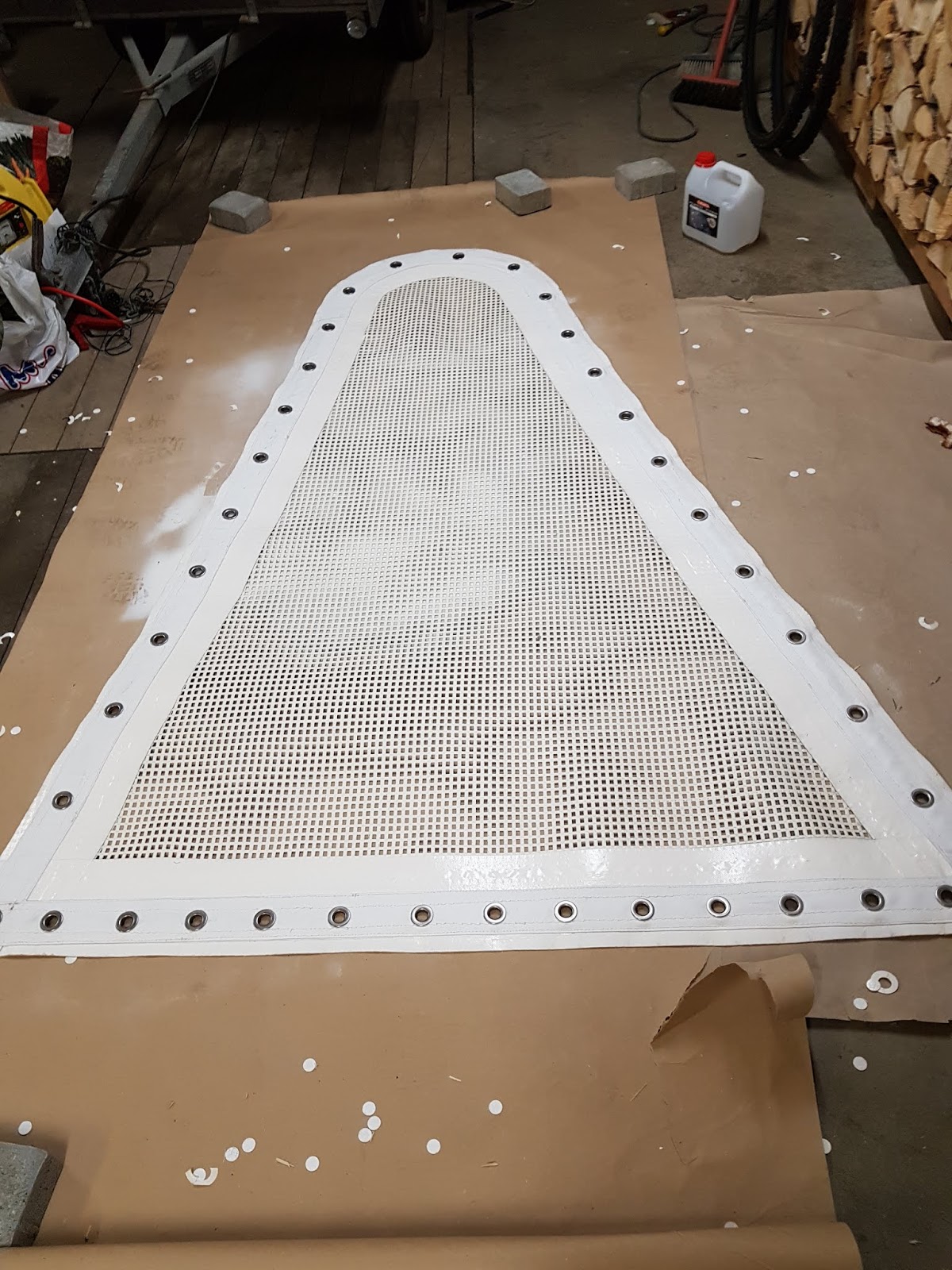
So a repair had to be considered. Several of the grommets were corroded to disintegration, all were showing some sign of corrosion. Around many of the grommets the fabric was stretched and torn so much that I feared new eyelets would not grip properly.


Some kind of reinforcement was necessary. And some high quality grommets. The original grommets were brass with some kind of coating, probably chrome. I wanted large stainless steel ones.

And again, as Norway is a small country with a limited marked for everything that is not quite common merchandise, I had to look abroad. As often before, the US had the solutions. For Norwegians, at a price. The largest grommets I found available in stainless steel were slightly more than an inch in diameter, US #5, from Fasnet. They were willing to ship to Norway, which is not always the case.
I wanted to use strips of heavy duty fabric along the rows of grommets to reinforce that area. The most promising I found was heavy duty vinyl coated polyester from Tarpsnow. Had to go through a reship service to get it home.

With the parts and materials available, a repair could be attempted. Luckily I discovered that the nets could be used with the reverse side up, if changing sides. They look fresher on the less exposed underside. 

I cut the strips, and a sailmaker sewed them on. The grommets came on nicely, and the end result looked good and promising. I hope the nets will now last for many more years.


onsdag 26. desember 2018

More macerator trouble experience.


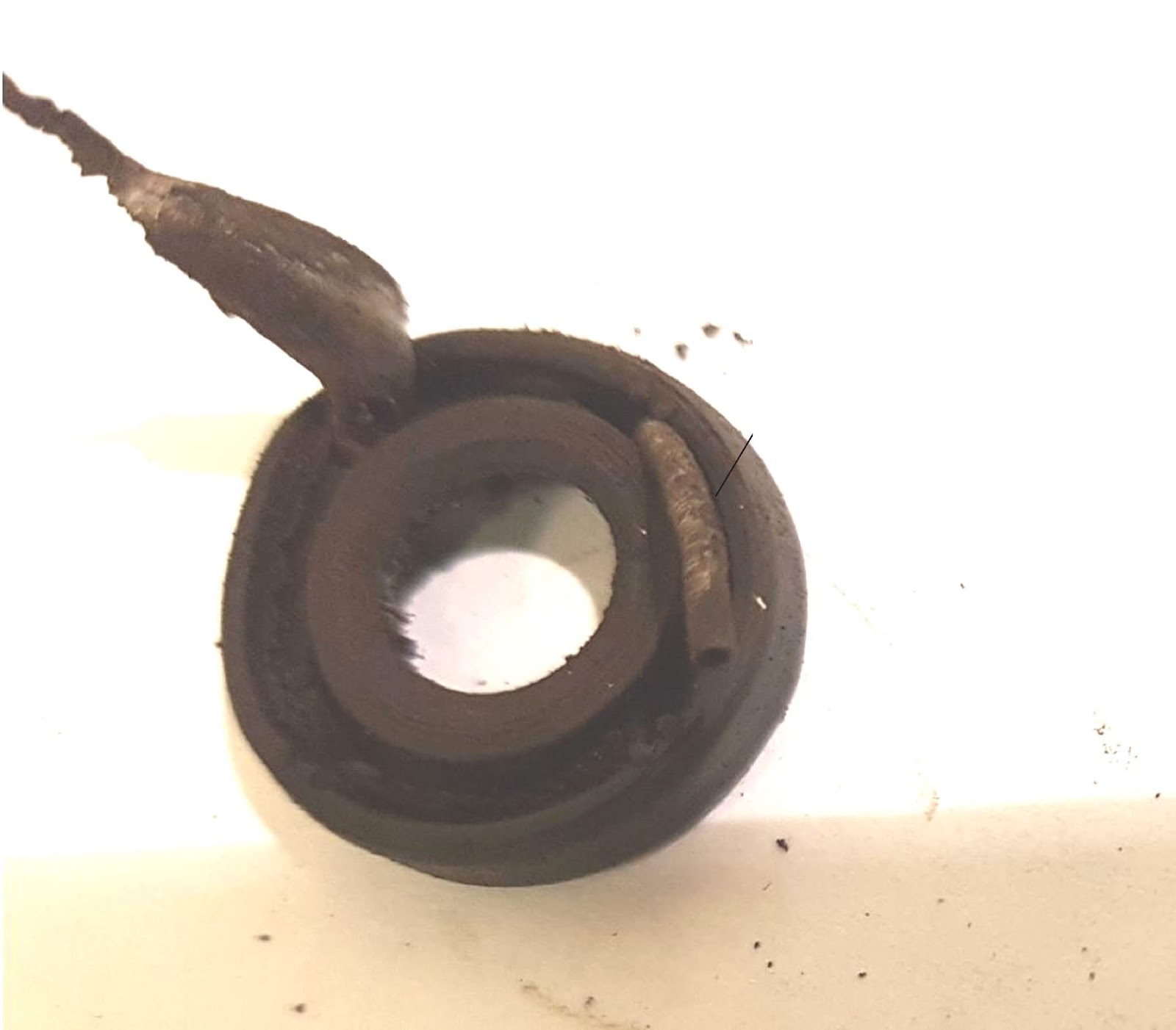
Changing gaskets in April this year did not fix the leak in the macerator. I should have checked more on Youtube about macerator overhaul. But at last I bagan suspecting another reason, and in particular the motor shaft seal ring. (11)


This was the only probable reason beside the gaskets. And removing the seal ring revealed that it was stiff and worn. Also, the inside tightening spring was rusty and probably inoperative.


When installing the new ring, I filled the spring with grease, hoping that it will prevent rust for a longer period. The next summer will show if the leak is stopped.

And testing in may 2019 it looks very promising. No leaks any more.


tirsdag 25. desember 2018


Checking the exhaust bend....at last.


I really try to take care of my 2 engines, honest. The oil is changed every year, dieselfilters quite often too, cooling fluid as well. The intake and exhaust valves have been adjusted a couple of times, cooling heat exchangers cleaned, transmission oil checked to be OK now and then. The two MD 2030's do not work a lot, they are mainly used in and out of harbours and anchorages. And they have not let us down, the only trouble being an occasional loose contact on the starter relay. Which can cause a bit of panic in the wrong moment, but it has not been critical.

But now I understand I have missed something important. Reading in social media about cooling problems, attention was directed towards the exhaust bends. Our engines have not overheated, and cooling seawater always came through. But I have never previously  checked the exhaust bends for clogging. It appeared to me that because the engines run mainly on low speed for maneuvering, exhaust deposits might form more easily in our engines.

So this autumn it was time to check this. And the suspicion was confirmed. The exhaust bends were quite badly clogged. Even though water came through, further clogging would have caused overheat. And I believe the power will be restricted when the engines can not breathe well.
So the exhaust bends were cleaned. But maybe some other issue is lurking around the corner, me happily ignorant about it....?


lørdag 16. juni 2018

A new Spade incident...


We sailed into the Limfjord (Jutland, Denmark) from the east, and would have to go through two lifting bridges before reaching the planned marina. A nice southeasterly wind brought us in to Aalborg at the right time for an hourly opening. But alas, a boat race was going on, and all traffic was stopped for more than an hour to come. So we had to find a place to stop and wait, and chose to drop the Spade in the vicinity of another sailboat which was also waiting. In the process, i came quite close to shallow water, so I did not want to back the anchor in as we otherwise always do. We were on watch to keep an eye of things anyway.

After a short while we recognized the unpleasant condition of anchoring in opposite current and wind. The current lined us up with the stern towards the wind, and the wind pushed us over the anchorchain. If the wind is strong enough and when anchored in shallow waters, this may easily keep scratching the anchor chain into the hull and keels. So we decided to try to find a place to tie up instead. As the Spade came up, it was like a mirror of what happened to us in Des Haies  in the Caribbean in 2015 (see previous post under this tab).


This is scary. It is the third time the Spade comes up with the chain wrapped around it, and in a condition that prevents it to reset. The two first times, there had been definite boat position shifts and drifting. But the anchor had been backed in.

It must be recognized that this last time is a bit special. The anchoring technique was really poor, I did not slowly drift back while the anchor chain came out (being cautious and preoccupied with assessing shallow water behind). Thus much of the chain was probably placed very close to the Spade. In addition I did not back it in. Had it not been for the previous incidents, I would not have reacted much to what I saw. Now however, I see a big problem with the two side "wings" (vinge) of the Spade. Due to these, the anchor chain will not slide free if the anchor is pulled or lifted. The Spade is effectively rendered useless, and the boat is free to drift. 

It seems like some second  and third and even more thoughts have to be made before anchoring with this anchor in shifting winds or currents. I believe the seabed has to be soft enough to bury the anchor so deep that the chain cannot creep under the "wings". This excludes rocky or hard clay seabed, maybe even seagrass, which normally might be OK under fairweather conditions. Unfortunately, in many parts of the world you can not see the bottom or your anchor through the water.

Spade anchors have shown good properties during tests regarding directional resetting. But this is with one strong directional reversal pull.

So is it time to change the anchor? It seems to me that Spade and Rocna are the overall winners of most anchor tests. We cannot use a Rocna due to the roll bar. And it seems the Rocna also has such wings, but maybe smaller. Maybe the Vulcan is a good alternative.

At least it is time to be even more conscious about seabed and anchor penetration when anchoring in shifting wind and current, even under light conditions.

torsdag 7. juni 2018

Calorifier installed


The installation is finished, Almost according to plans. The power supply cables had to be changed after the initial installation. I used a cable dimension approximtely equal to the short one supplied on the calorifier. Too thin. The power supply cable from the circuit breaker box is around 3 meters long, and it got warm (not hot) when power was switched on. This of course means an energy loss, and new cables, believed to be around 10mm2 was installed. That was much better.


And speaking about energy, an effort is made to save every Joule possible. The picture shows the extra insulation laid around metal parts (tubing connections) that leak heat from the water in the tank.

From quite cold water it took more than one and a half hour to heat up the tank. Less now that the summer has arrived. Calculating from a 25A consumption and 1 1/2 hrs, this means around 40Ah spent. The first testing period has been very sunny and also given some wind, thus the surplus energy I mentioned in the previous post has been present. And the heater has been used every day. It would have been nice to have Lithium batteries, then I could have "borrowed" more power on overcast days without being concerned about recharging lead batteries. 

But the amount of well heated water is quite limited. All such tanks take in cold water for pressure in the bottom, and as the tank is small, it seems to mix in fairly rapidly. Still, it is nice to have some hot tap water for rinsing the greasy frying pans and pots. Warmed by surplus energy otherwise not available for use.


lørdag 12. mai 2018


Calorifier....?

What is that? As a Norwegian I had never heard the word before starting to look for a 12 Volt water heater.

Luckily, nowadays boat equipment steadily improves with time. Comfort levels rise, and possibilities increase. On the Lucky Strike we now have a fairly comfortable amount of solar panels. Enough to keep the batteries charged most of the time when not using shore power (which is almost all the time). In addition there is a wind generator and of course the engine generators. Even though the batteries are old fashioned AGM that requires much energy to enter top charged condition, on sunny and/or windy days we actually have an energy surplus. But this surplus ends up blocked by the solar regulator or being led into the wind generator dump load. That means it is useless.

We would like our boat to be well equipped for cruising, and this means being independant of shore power and also use the engines as little as possible for battery charging and hot water production.
Our concept has a weakness from a comfort point of view regarding hot water. Without shore power, the only hot tap water source is the port engine coolant fluid. The hot water tank is 40 liters, so the engine use when entering a harbour or when anchoring is by no means enough to heat it. In addition, we usually motor on one engine ony, which means that no hot water is produced when it is the starboard engine's turn to contribute. It would be nice to have a more available source of hot water, be it only for dishwashing, personal hygiene or a short shower.

It will have to work on 12V. And thus be quite limited in volume. And the immersion heater in it must not load the batteries too heavily, better to use a bit more time with less power.


Is this the solution?


It draws around 25A. I do not know how long it takes to heat up to acceptable temperature. But I presume that it will vary a lot with the starting temperature.  Big advantage is that it will be usable with the starboard engine producing electricity.

A possible setup will be to use a selector valve between the 2 tanks hot water feed line to the galley and owners suite.

So I have ordered one. Hope to be able to install it this summer. It would be very exciting to see how it turns out.


tirsdag 24. april 2018

Macerator through bolt failure again.


Found the macerator leaking this spring. Once again, brass through bolts had broken, 2 of 4 this time.
In the other macerator I have fitted stainless steel replacements, simply made out of treaded bars.

Maybe the frost has broken the brass. But I have of course run the system with anti-freeze in the autumn. The only question then is if it was enough. The steel reinforced one did not break.

So I am still a firm believer that the brass used by the manufacturers is too weak. Causing unnecessary failures. I also think many boatowners do not want to mess with macerators. Which then boosts the sale.

I did fit stainless steel into the failed macerator. Time will show how it works.


søndag 8. april 2018


How you could (but probably should not) make a
bimini hardtop.


I will make my blog post in english again, because it seems there are many foreign readers.  

Most modern cruising catamarans have some kind of bimini installed. On a catamaran this is a great and cost effective way to increase living space on board, as the cockpit area is often spaceous. The main manufacturers realized this many years ago, and now integrate hard biminis on their cruising models.

The composite hard bimini has many advantages. It is very durable, strong and completely water proof. It is fairly easy to attach many solar panels and also water collection systems to it. On the underside lamps and gear storage equipment can easily be mounted almost anywhere. A composite hardtop bimini can be left in place permanently with minimal effects from weather. If built strong enough, the hard bimini can be walked upon, rendering easier and more safe access to the full lenght of the boom. In addition, by building a curved (convex) surface, water pools that can easily form on large canvas biminis will be avoided.

The downside is added weight and cost/labour. For some, the loss of the canvas removal option for storm preparation might also be a barrier. 


We (my poor wife is involved in all kinds of wild projects) have changed the original bimini cloth only once in 14 years. But the advantages of a hard structure are tempting, so when a long distance trip of several years was planned, an effort to build a hardtop was initiated in the winter of 2013/2014.

The Norwegian winter is not ideal for home building of large composite structures. Especially in the area north of Oslo. Temperatures are mostly below freezing, and a spaceous heatable garage area will be needed. Luckily we have a quite large garage, and part of it was sectioned off with tarpaulin walls to minimize the heating requirement.

The first challenge was to dismount the bimini stainless steel frame and trailer it home. It passed through the marina pontoon gate only using advanced twisting motion and hardly an inch clearance. On our tiny car trailer it looked a bit oversize.


The somewhat ambitious plan was to build a plug on top of the frame and then lay up a fiberglass mould on top of that. So why did we want the same size and shape as the old bimini? For one thing, the old stainless steel frame or main parts of it could be used. Fitting would be easier that way. And I actually did not want to build the hardtop overly strong due to weight considerations. It would be fine only to be able to walk reinforced areas along the boom. Kind of the same concept as a canvas bimini. Many would have made the hardtop a bit larger than the original to have better sun protection. Unfortunately it is very probable that our time on the catamaran will be longer in northern latitudes where we need the sun, than in the tropics. We also have a winterization problem. I like to have the main parts of the boat under a tarpaulin which is laid over the boom, and the wider the hardtop, the more exposed it would be to snow loads. The final argument for my choice is esthetic. I think the flatter shapes looks better and works better in the warm climates.


 Starting building the plug.

A plug can be made of sheets of fiberboard. If you do it the right way. The right way requires much time and effort. For us neither was abundantly available. We had a lot of other projects going because of the planned departure late in May 2014. Another consideration was that this was a one-off project, so the mould would be used one single time and not for further production. Being pressed on time, it seemed sensible not to put more effort into it than absolutely necessary.


The plug skin almost finished. The fiberboard must be thick enough to compensate for the layers that will later be built up in the mould. This to ensure that the hardtop will fit on top and outside the stainless steel  frame.


Nevertheless it was quite some work to shape the plug. And make it ready for the special tooling gelcoat. Reading about such gelcoat, one is warned that the plug surface must be painted with many layers of polyurethane paint to avoid it adhering to the plug. 

Makers of such instructions usually exaggerate to be on the safe side, don't they? And do they know how hard polyurethane gets and how much work it is to sand down the wave pattern from the paint roller? And furthermore, how easy it is to sand through to the fiber board around edges? Probably not....

To avoid that the mould would stick to the plug, many layers of Carnuba wax was put on the plug.


Then came a hard days work . Laying out the mould gelcoat. Laying up layers of fiberglass chopped strand mat. Cutting and shaping 20 mm Bonocell foam (for stiffness), and laying up the top layer of chopped strand mat.


Resulting in this top view of the mould at the end of the day.


The  inside of the mould did not turn out satisfactorily. More like a disaster, actually. The fiber board stuck to the gelcoat along edges, and the inside of the mould was more or less a mess because of bonding to the plug. But it generally had the correct shape, so giving up was not an option. 


By filling and sanding the mould was smoothened, and then painted with spray paint. Epoxy is much more forgiving than gelcoat when it comes to not dissolving the underlying surface, right?


I mentioned added weight as one of the drawbacks of adding a hardtop bimini. I have wanted to limit that drawback as much as possible. And have tried to find ways to save some weight. We have all read about the fantastic strength and weight savings of vacuum bagging techniques. So in that lies a possibility. Youtube videos explain how easy this is, and information sources tell you the opportunity must not be missed if you want to save weight and gain strength.

Unfortunately bagging equipment is not so readily available for retail in Norway. I envy the americans, their domestic market is so huge that just about anything is easily purchased, and at a reasonable price. 
Turning to that market is a solution, even though our VAT and the shipping cost increase prices significantly.
New words now came into my vocabulary. Peel Ply, Vacuum Bag, Bagging Release Film, Bleeder Breather Cloth, Tacky Tape Vacuum Bag Seal, Nylon Vacuum Bag Bagging Infusion Film, Resin Trap, etc.  
A vacuum pump is also needed. These are in no way meant for a single occasion use, they are quite expensive. But again, internet is the saviour. I found information that a refrigerator compressor unit can be used. Easily taken from an electric appliance dump.


The process of acquiring all the necessary gear took some months, But at last we were ready for a very hard and stressing day. All the fiber glass weave had been pre-cut to shape, likewise the 10mm Divinycell foam and the vacuum bagging equipment. The vacuum pump was tested to be working and ready. 

The epoxy resin hardener was specified as slow, still we knew that we had to work fast. But laying out epoxy, top and bottom layers of weave and the foam on such a large area took a lot of time. In addition the rim and hatch area had to be set up. But worst of all, the hardener was not very slow. Already after the first 2 layers of weave, I felt failure creeping in over us. The resin started to get viscous. Even frantic work could not save us. When all the layers were in and the vacuum bag sealed, it was already too late. It did not help us a lot that the homemade vacuum pump was way too weak to do its job, but it could not have saved the day anyway.


As suspected, after having a hard time getting the bimini out of the mould (release problems again), it was clear that it could not be used. It delaminated easily because of insufficient bond between the layers. Departure date for the Caribbean  was coming close, so there would be no hardtop bimini for that voyage.


The product had to be cut in pieces and taken to the dump.


Lesson learned is that if vacuum bagging a project of this size, infusion technique should be used. In addition I suspect that the epoxy resin and hardener may have been old, and therefore curing too fast. When using leftovers of the same stuff now, it starts curing really fast.


None of us thought that we would ever want to try such a project again, but the mould was anyway hoisted up under the garage roof for storage before departure.


The canvas bimini did its job fine during the two year cruise. But the weather and use wore on it. And after returning home the thoughts of a hardtop again surfaced when repairs were necessary. In the autumn of 2017 the mould was taken down from the roof and rigged on the garage floor. It was going to be difficult to use it, as the gelcoat inside was damaged after the first use. So I expected to have to repair the final product extensively. But a new mould was not an option, way too much work.

Like the first project, this would be epoxy and divinycell based. I have learned that the common gelcoat topping can not be used  in such projects, it is polyester based and does not match well with epoxy. Paint is thus the usual top coat. And in that case some surface work will be needed anyway.

Divinycell comes in sheets, precut into small squares and uncut sheets. I like the precut. The 3 x 3 cm squares are glued on one side to a thin glass fiber weave with a small gap between each square. Thus the sheet takes the shape of the underlying mould much more easily, and does not have to be weighted down so carefully. Another advantage is that resin fills the gaps in the sandwich construction, so no specific holes or areas to bond the upper and bottom layer to prevent layer skidding are necessary. On the other hand this concept may require more resin and be a bit heavier.

When buying glass fiber weave this time, I also learned of twill weave. Again, this type of weave is much softer and will shape around spheres and corners much better than ordinary weave. The only small disadvantage is that after cutting out a shape, it must be handled carefully because it easily twists out of shape.

Epoxy resin is more expensive than polyester. My reason for using epoxy was again weight considerations. Epoxy/fiberglass is a very strong mix, stronger than building with polyester or vinylester.  I do not think it is lighter per se, but one can use less materials for the same strenght, thus there is a weight saving potential.

Before the first attempt I had made a couple of test sheets, and found 2 layers of 300 grams glass fiber weave each side of 10mm divinycell very promising. I did use the same in the second attempt.


Here is the hardtop plan.

Without the stress of the vacuum bagging setup, the casting of the hardtop was a bit easier. One should however remember that if too much time elapses between layers, the surface must be rinsed before continuing. This is because of the so called Amine Blush, the next layer might have problems sticking to the previous.


Laying epoxy, fiberglass and divinycell in the mould.


With my substandard mould inner surface layer, I knew I had to expect problems with getting the product out of the mould. So I did follow the advice of attaching a tube to the underside before casting. With a piece of tape on top to prevent resin escaping that way. Good move, without it the job of getting the hardtop out would have been a nightmare. Now I could pump in pressurized air from the bottom. Which made the difference.

And no, the product surface was not perfect. It was repair time in sevaral ways. In some smaller areas I had to re-bond the upper surface due to too little resin used. ("weight saving" is not always a success). And the whole surface did of course have to be sanded and smoothed before painting.


Polyurethane paint was used as the top layer. Using a paint roller will not give the same finish as sparaying, but spray painting polyurethane in the garage was not worth the trouble for me.

Our original plan included a sliding hatch, but when I discovered that the front and back of the hatch opening inclined at very different angles, I realized that it would be complicated. So the solution was a folding hatch from canvas and composite planks. Luckily my wife is now quite experienced in sewing canvas.

When the hardtop was mounted, it became clear that it was quite stiff and strong, at least when using it atop the stainless steel frame.  (Also, below the gangways the thickness was doubled). I had beforehand cut away some obviously superfluous sections of the frame, and plan to cut more. But first we would like to observe how the hardtop works the next season and winter.

In our home climate canvas sidewalls is a necessity. For mounting these. we chose  to use a band of canvas around the edge, supporting YK 10 zippers. The canvas was caulked onto the inside, We will find out if it has to be supported by screws.

The original dream for the project was that it would be all composite and that the stainless steel frame could be taken away. It weighs 40 kg. I believe it is absolutely possible, but it would require  a lot more work and time. Having the boat an hour drive from home would also complicate such a solution a lot. Not to speak of the long season of temperatures when it is too cold for outdoor composite work. In the summer we want to cruise, not work.
So the hardtop now adds approximately 33 kg (73 lbs) of weight, hatch included. ( It is a bit heavier, I deduct the old canvas and the cutaway stainless steel parts).

But as everyone who has added one, we think it will be worth it all.


.


The great day of mounting it.


søndag 17. juli 2016


God erfaring med nedlasting av GRIB via Iridium denne gang.


På vei til Karibien strevde jeg mye med Mailasail sitt opplegg. Hadde vanskeligheter med å få koblet opp til nettet og serveren deres, telefonen koblet av for tidlig når Redbox ikke registrerte aktivitet.
Ekstra dyrt ble det også, de tok betalt for tilgangen til mailsystemet sitt.

Så på tilbakeveien ble det å prøve noe annet. Hadde hørt at Iridium Axcess Point virket bra for andre. Dermed ble det anskaffet en slik. Selv om denne er relativt gammel teknologi, og selv om Iridium selv offisielt ikke støtter denne lenger. De vil heller selge GO, som er mye dyrere.

Vi bruker eksakt det samme Iridium basisutstyret som før.

Nå skal det sies at det er litt konfigurering av det nye opplegget også, og jeg kontaktet Iridium for å få det til fungere sammen med appen Iridium Mail and Web. Men når det først var i gang, funket det veldig bra synes jeg. Vi lastet ned ganske så mange store GRIBfiler, og selv om det ble noen få feiloppkoblinger og nedlastingsavbrudd (sikkert pga dårlig satellittsignal), så var det aldri tvil om at vi kom til å få de væropplysningene vi bestilte.

Dette er jo også takket være Saildocs, som har en server som svarer lynraskt på forespørslene og har et stort utvalg av nedlastbar informasjon. Tjenestene er gratis fra deres side (man har jo utgifter til Iridium internett, selvfølgelig).

Jeg synes kommunikasjonen gikk ganske effektivt. Appen bruker visstnok kompresjonsteknikk. Ut-mailen gikk totalt gjerne på under et minutt. Til Azorene tok vi ned store GRIBfiler, rundt 25kb. De kostet vel rundt 3 minutter.


Skjematisk tegning av satellittopplegget for hjemturen.


I appen Iridium Mail and Web er det en loggfunksjon som viser hva som skjer under oppkobling, opp/nedlasting og nedkobling. (Nedkobling etter mottak av mail virket ikke, måtte slå av manuelt)

tirsdag 17. mai 2016


Forskjellige GRIB-lesere til forskjellige formål.


Et av mine GRIB favorittprogrammer ved siden av zyGrib er qtVlm. zyGrib er et enklere program å få til å fungere synes jeg, med muligheter til enklere visning av flere forskjellige typer værdata.

Og qtVlm kan virke noe mer komplisert å komme i gang med og forstå. En god del funksjoner bruker jeg ikke, andre som jeg kunne tenke meg å bruke får jeg ikke til. Det er ikke så farlig, det som jeg synes er så bra med qtVlm er den seiltaktiske oversikten visningen gir når man er ute på sjøen. 

Vindpilene sitter så tett som hagl. Kombinert med båtens GPS-posisjon gir dette raskt og nøyaktig overblikk over varslet vindvinkel og styrke. (De fleste som reiser på båttur med PC har vel med seg en kompatibel GPS). Ved å sette inn distansemerker langs ruta via «Marks» funksjonen, får man enda lettere se vinden som venter i diverse posisjoner der fremme. Og kan legge ruta fordelaktig i forhold til prognosene. Så får man bare huske at prognoser av og til ikke stemmer. (Men hva er alternativet?)


Programmet interpolerer til detalj også de GRIB filer som har lavere tidsnøyaktighet enn den man velger å se. Akkurat det kan jo også gi uventete unøyaktigheter, men nåtidens ferske GRIB filer er som regel så bra at det ikke er et problem. Og min egen interpolering blir veldig omtrentlig eller uforholdsmessig tidkrevende uten bedre resultat.


Lucky Strike korrigerer gradvis sørover på vei mot Bermuda etter å ha gått nord for høytrykk og vindstille. Dagsetapper ligger merket langs direkteruta.


Som nevnt synes jeg qtVlm kan være litt komplisert å få i gang. Hos meg er det heller ikke helt stabilt, krasjer av og til. Ikke så farlig, bare å starte igjen. Hjemmesidene er videre nokså rotete, men har man holdt på litt med PC så finner man ut av det. Husk å merke av for nedlasting av kart for å få bra funksjonalitet. GPS må konfigureres til egen com port. Programmet har egen nedlastingsfunksjon for GRIB. Dersom man liker å hente GRIB på andre måter, slik som jeg, må man hente dem andre steder på PC via «Open Grib». Ellers må man prøve seg frem for å få det til som man ønsker å ha det.


fredag 15. april 2016


Mickey Mouse spilebokser,


Før avreise ble storseilet omsydd fra rullebom til konvensjonelt med sleider. Det ble nødvendigvis satt på spilebokser ved forliket, en av ulempene ved rullebom og boltrope på forliket er at spilene blir presset fram og sliter på spilelommene. Spilebokser kan ikke brukes fordi de øker rullediameteren for mye og kompliserer innrullingsprosessen.

Seilmakeren satte på Antal spilebokser. Sikkert en tilgjengelighets- og kostnadsvurdering, men for et stort katamaranseil med ekstrem roach er disse flesne greier. Stort seil gir lange spiler med kraftigere vridninger og kompresjon. Det varte ikke så veldig lenge før spileboksene begynte å gi seg. Jeg hadde vært forutseende nok til å kjøpe noen i reserve, men de holdt naturligvis ikke så altfor lenge de heller. Det var spesielt en spile som var utsatt. Måtte kjøpe 4 nye Antal spilebokser til kr 600 pr stk i Martinique. Vill pris, det er bare noen små plastklumper. Prøvde å se etter andre modeller, men fant ikke noe som passet.

Spileboksene fortsatte å gi seg, så søket etter alternativer ble intensivert etter å ha seilt en stund uten den spilen som var mest utsatt. Fant så til slutt Schaefer 1900-10, som er dobbelt så lange og sikkert 4 ganger så kraftige. Kostet 800 kr pr stk, sikkert 1000,- hjemme, så hvis man skal ha til 7 spiler så blir det en stor ekstrakostnad. Jeg nøyde meg med 4 til de lengste og mest krevende spilene. Og er spent på hvordan de fungerer. En fordel med dem er at de også har spenningsjustering.

Antal har mye bra, men spileboksene er skrot på store seil.


Antal


Schaefer 1900-10

lørdag 30. januar 2016


E-post vær

(Utgangspunktet for meg er PC)


GRIB-filer er nyttige på korte og lange turer. Lett tilgjengelige dersom du har internett. Er linjen skikkelig smalbånd, kan det være verd å prøve å få informasjon via e-post. Det krever lite nett, og brukes mye på satelittkommunikasjon.
Mange blir ledet inn i betalingstjenester, men det finnes gratis muligheter som er bra også. 

Saildocs får jeg alltid svar på. Her dreier det seg om kun GRIB filer.

Prøv å send til:       query@saildocs.com

ikke noe emne, og

send gfs:14N,15N,60W,62W   (send kun dette)

(Det har vært en feil med denne koden. Beklager hvis noen har prøvd den og fått feilmelding. Kolon er nå satt inn, skal funke.)

Du får ganske raskt svar tilbake med en GRIB fil, mindre enn en kB. Den dekker ca De Små Antillene.
Filen kan brukes i Open CPN (musepeker gir interpolering), qtvlm (bra interpolering), PC plotter og sikkert mange flere programmer.
Det finnes mange muligheter innen Saildocs. En liten vitenskap her. 


Prøv å send til:      ftpmail@ftpmail.nws.noaa.gov

ikke noe emne, og

open
cd fax
get PYEA11.TIF
quit

Værkartene som du får er ca 34 kB. Jeg opplever ikke 100% tilbakesvar her. Men de lover ikke det heller, opp til en time å vente skrives det. Men det ser ut som svaret kommer ganske raskt om du får noe.
Det finnes enormt mange kart å velge mellom. En liten vitenskap her også.


                                         GRIB Qtvlm


                                             GRIB Open CPN


                                        Typisk værfax kart.


lørdag 23. januar 2016


Nedenforstående var riktig i Turks and Caicos. Etter å ha seilt i Bahamas noen uker, ville vi på ingen måte vært uten Explorer-kartene. Det ville vært enormt begrensende.


Explorer Chartbook

Vi har latt oss fortelle av medseilere, (og har jo også sett i reklame) at i Bahamas må man ganske enkelt bare ha Explorer - kart i papir. Man får ikke de samme detaljene med plotter. 

OK, så kjøpte vi Explorer Chartbook for Bahamas på nett og klarte å få kartene sendt til St.Thomas.
Men da vi begynte å bruke dem i Turks and Caicos, var de egentlig ganske skuffende. For vi opplever det omvendt. Vi får flere detaljer og flere dybdepunkter på plotteren. Det finnes en del annen bra informasjon i disse kartbøkene også, riktignok, men vi hadde jo kjøpt Cruising Guide fra før, og der finnes jo det samme.
Vi har Navionics kart på plotteren. Der finnes også mesteparten av de anbefalte rutene i grunt farvann som vises i Explorer-kartene. Det sies vel at Navionics-kartene ikke er 100% riktige overalt, men alle som publiserer kart tar forbehold, og skriver at man ikke må navigere på grunnlag av disse alene.

Har man Cruising Guide og bra plotterkart, ser det ut til at Explorer-kart er en unødvendig utgift. OBS, se under!


Bildene er kanskje ikke tydelige nok, men Navionics gir flere dybdepunkter enn Explorer. Verdifullt i grunne farvann, selv om man ikke kan stole 100% på dem.


Oppdatering feb 2016:

Når vi har vært en stund i selve Bahamas, så finner vi at erfaringen fra Turks and Caicos ikke stemmer lenger. Vi ser at det er mange steder og ankringsplasser som hadde vært litt vel spennede å våge seg inn i uten Explorer - kartene. Explorer gir anbefalte ruter inn til grunne områder med bra dybdedata. Nå er vi glade for at vi har dem :).


fredag 15. januar 2016


 MER OM ANKRING


Forheksede ankerplasser…?


Noen steder oppfører båten seg uventet og merkelig under ankring. Kombinasjonen vind og strøm kan gi underlige bevegelser. Ved South Caicos ankret vi over grunt vann et sted hvor vi dermed kunne forvente noe tidevanns-strøm. Hovedregelen er jo at strømmen vinner over vinden. Så kan man jo la båten og ankerkjettingen drifte med strømmen hvis det er bunnforhold og plass til det, eller sette opp med to anker og ankerliner (Bahamian moor). Den siste løsningen krever jo litt ekstra styr, så de fleste bruker den ikke hvis de ikke må. Plass og greie bunnforhold hadde vi. Da tidevannet kom, rettet båten seg inn mot strømmen som forventet. Med hekken rett opp i vinden. Men den drev ikke avgårde med strømmen. Vinden var ganske moderat, men likevel dyttet den båten opp mot strømmen slik at båten kjørte over ankerkjettingen og tidvis dreide i andre retninger og også gjorde piruetter. Ankerkjettingen ble liggende som en krøll i området rundt båten. Det var ikke store krefter i sving, så ikke noe stort problem, men uvanlig og underlig å observere.


På svai med vinden i hekken.


Ankring under forhold med svell.


Da vi skulle ankre i ly av en liten øy, så vi at det var noe svell i ankerområdet. Men ikke verre enn at det var helt akseptabelt. Lange svell er bedre enn bølger. Som de fleste andre så bakker vi alltid ankeret fast. Bruker et tau med krok for å avlaste ankervinsjen når det dras til, som en kort rykkdemper. Hanefoten festes så etterpå. Samme prosedyre denne gang. Ikke så smart. Da ankerkjettingen var bakket stram, kom det svell og løftet båten. Pang! Der røyk avlastingstauet, og en meter kjetting raste ut. Bra vi hadde rykkdemper, selv om den røyk. Ankerbeslaget var uskadd. Heretter drar vi fast etter at hanefoten er satt på når det er svell.

(Grunnen til at vi ikke setter hanefoten på først under normale forhold, er jo at det blir mere jobb dersom vi ikke får feste eller vil ankre om av andre årsaker.)


fredag 1. januar 2016


Hva er topplading?

Batterilading er et tema som er overraskende omfattende. Særlig etter at mange «nye» konsepter har kommet de siste årene. (Nye står i anførselstegn fordi AGM,  sealed gel og lignende fremdeles er bly/syre batterier. Men det finnes jo helt nye saker også, som LiFePO4.)
Selv har vi den eldste teknologien som er tilgjengelig. Åpne bly/syre. Noen påstår det er de mest kostnadseffektive. Andre sverger til nyere konsepter.
Blybatterier trives godt med å være fullt oppladet. Og mistrives med å være utladet. Det går visstnok an å beregne et batteriliv på grunnlag av såkalte sykluser, utladninger og oppladinger. Batterilivet består av et visst antall slike. Dersom man legger dette til grunn, er langturseiling ofte drepen for batteriene. Hjemme står de ofte lenge perioder på «float» lading, og misbrukes kun i kortere perioder i sommersesongen med diverse sykluser. Men også da er landstrøm rimelig lett tilgjengelig, noe som sørger for toppladingen som batterier trenger. På langtur er misbruket konstant dersom man ikke har usedvanlig bra ladesystem, mange solcellepaneler og vindgenerator samt hydrogenerator og diesel/bensingenerator som man er villig til å bruke mye. Det jeg  benevner «misbruk» er at batteriene tappes mye ned nesten hver natt, noe som tilsier at det blir en syklus med utlading og bare delvis opplading hvert døgn. Altså ikke lading helt til topp igjen hver gang.

For topplading er krevende å få til. Når batteriene nærmer seg fulle, kreves det mye ladetrykk for å få inn den siste viktige toppladingen. Dersom den ikke kommer, blir det sulfatering og kapasitetstap i batteriene. Når jeg studerer laderegulatorer, så er de jeg har sett på satt opp for å kjøre lading på 14,2V-14,5V i et par timer dersom det er nok strøm tilgjengelig til det. Deretter senkes spenningen til  ca 13,2V-13,8V. For å hindre koking og gassing av batterisyra.

Jeg lurer litt på hva langturfolket bruker som definisjon på fulladede batterier. 100% på en batterimonitor? 12,7V hvilespenning? (Batteriene er alltid i bruk, så hvilespenning ser man vel aldri?). 14,4V oppnådd på topp ladespenning? Jeg bruker det siste, dersom ca 14,4V har stått i minst et par timer.
Egentlig har jeg lyst til å kjøre toppspenningen i enda lenger tid. De fleste laderegulatorer tillater ikke det. (Det kan være en mulighet å ta strømmen og «resette» på den måten). På vindgeneratoren har vi en litt «Reodor» regulator hvor man manuelt kan sette Bulk og Absorb spenning. Det gir muligheter for litt ekstra trykk. Det trengs som sagt en del strøm til dette. Og etter litt tid på høy spenning, så vil ikke solcelleregulatoren være med på  å hjelpe mer. Så det er bare når det er mye vind at vi klarer å kjøre batteriene litt ekstra. Har lyst til å justere opp til 14,5-14,6V også, men prøver å se an litt først. Skadelig med så høy spenning?


Komponentregulator med fjernstyring av ON/OFF på vindgenereator.


For det skal jo være bra for batteriene å få et lite «oppkok» av og til? Det hjelper visstnok til med å forhindre sulfatering?  Det finnes jo såkalt Equlization prosedyre for slikt, litt komplisert sådan, som krever tilgang til nok strøm. Det gjelder kanskje mest åpne bly/syre batterier. En fordel med disse er jo at man kan holde kontroll med batterisyrenivået og etterfylle det som gasser bort.    

Vi har dessverre også litt for små batterier i forhold til forbruk. 4x100 Ah. Men i Karibien får man ikke uten videre kjøpt det man helst vil ha. Batteripolenes posisjon og batterikassenes utforming spilte også inn for oss. Men etter bare et års bruk, synes jeg at kapasiteten er merkbart redusert. Uunngåelig dersom man ikke vil gå en time eller to på motor (eller kjøre aggregat) hver dag?


onsdag 16. desember 2015


Jeg har reflektert litt over kvaliteten på billige solcellepaneler her før. Dette er bare en liten oppfølger som fremdeles tilsier at «Cheap China» ikke holder så lenge.


Dette 80W panelet ble, bare som en kuriositet,  kjøpt av den nå ganske «renommerte» Enrique i Puerto Rico, Gran Canaria høsten 2014. Han fremstilte det aldri som noe kvalitetsprodukt.  Det er nå altså litt over et år gammelt. Det er matt, og diverse laminerte plastlag løsner.
Har ikke målt hvor mye, men det virker som om det leverer noe strøm. Enn så lenge. 250€ er vel ikke så dyrt for et såpass stort panel, men når det ikke tåler maritim bruk, blir det jo en dårlig investering. Men det er jo ikke bare greit å velge alternativt heller. Båtutstyrsbutikkene nedover «melkeruta» ligger som regel ikke med slikt på lager, det koster ekstra tid og penger å bestille om de over hode kan levere noe. Direkte fra nett er heller ikke enkelt når man er ute på tur, igjen må man enten planlegge svært godt eller ligge og vente på leveranse. Og i bakgrunnen lurer diverse stivbeinte tollmyndigheter som kan gjøre livet surt i ukesvis for en stakkars seiler. I tillegg til at de skal ha penger.
Moralen er. Ha dette mest mulig i orden før avreise. Som det meste annet.

Cheap China er skrot som kan brukes i en begrenset periode.